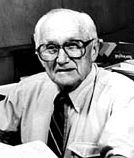
BA, Oklahoma City
University (1941); MA, University of Texas - Austin (1944); PhD,
University of California - Berkeley (1947)
Email: tommorgan@mail.utexas.edu
Office:
WEL 3.416
Phone: (512) 471-5266
FAX: (512) 471-8696
My initial research efforts
were in Nuclear Chemistry on the Manhattan Project at the University of
Chicago, 1944-1945. There, I was a member of the research team which
successfully isolated and identified elements 95 (americium) and 96
(curium) and was credited with a share in the discovery of americium. In
1946, I continued research on the tracer and nuclear chemistries of the
heaviest elements and received the Ph.D. degree in 1947 at the University
of California (Berkeley).
In 1947, I joined the faculty of the University of Texas, where I
initiated a program in nuclear and radiochemistry, primarily of the
elements tungsten, rhenium, and osmium, and of electrochemical processes.
During the early fifties the interests of my research students shifted to
magnetic resonance relaxation as a tool for investigation of structural
and dynamical properties of complex solution species. A theory of
electron-nuclear interactions leading to enhanced spin relaxation, the
Solomon-Bloembergen-Morgan (SBM) theory, was developed. That is the basis
for much of the image enhancement in current magnetic resonance imaging
(MRI).
My most recent research efforts have been devoted to solutions of
complex transition metal species, with an emphasis on those of biological
interest, such as the iron-porphyrin structures in hemoglobin and
cytochrome-c.
©2001 Welch Web Administration, The University of Texas at Austin